Overview
The software supply chain is increasingly the target of sophisticated attacks. In early 2026, a real-world incident demonstrated how threat actors can compromise a trusted vendor's distribution infrastructure. The CPU-Z watering hole attack saw cpuid.com serving malware through its official download button for nearly 19 hours. Attackers gained API-level access to the CPUID domain and silently redirected legitimate download requests to attacker-controlled servers. Unsuspecting users who navigated directly to the official site received a legitimate, properly signed binary—but with a malicious payload bundled inside. This tutorial walks through how SentinelOne's AI-driven endpoint detection and response (EDR) system autonomously blocked that attack, and provides a blueprint for defenders to understand and mitigate similar threats.

We'll cover the attack chain, the behavioral indicators that triggered detection, the automated response, and common pitfalls that can leave organizations exposed. By the end, you'll have a clear framework for evaluating your own supply chain security posture.
Prerequisites
To get the most from this guide, you should have:
- Basic understanding of endpoint security – familiarity with processes, memory, and system calls.
- Knowledge of supply chain risks – awareness that trust in vendors can be subverted.
- Access to an EDR tool – ideally one with behavioral AI capabilities, but the principles apply broadly.
- Familiarity with Windows internals – process injection, PE structure, PowerShell, and .NET compilers.
No prior experience with SentinelOne is required. The concepts are vendor-neutral where possible.
Step-by-Step Instructions
Step 1: Identify the Threat Vector – API Compromise
The first line of defense is understanding how an attacker can breach the supply chain. In the CPU-Z incident, the attackers didn't hack the build server or trick a developer. Instead, they compromised the distribution channel–the API that controls download redirects. This meant that even though the binary was digitally signed by CPUID, it contained a hidden payload. Lesson: Never assume a signed binary from a known site is safe. Always monitor process behavior after execution.
Action: Configure your EDR to baseline normal behavior for commonly downloaded utilities. For example, CPU-Z.exe should not spawn PowerShell, compile C# code, or perform reflective loading. If it does, it's likely compromised.
Step 2: Behavioral Detection – The Five Indicators
When the malicious cpuz_x64.exe executed, SentinelOne's AI EDR flagged five converging behavioral signals. These are the red flags you should look for in any suspicious process:
- Anomalous API resolution – The process bypassed the normal Windows loader (e.g., using
LdrGetProcedureAddressor manual parsing ofPEB) to locate system functions. This evasion technique hides import tables from static analysis. - Reflective code loading – Executable code ran from memory regions not backed by a disk file. Attackers often load DLLs or shellcode reflectively to avoid writing to disk.
- Suspicious memory allocation – Memory permissions changed to Read-Write-Execute (RWX). Legitimate applications rarely allocate RWX pages; this is a strong indicator of shellcode or unpacking.
- Process injection patterns – The execution flow was redirected into another process (e.g.,
svchost.exeorexplorer.exe) to mask the origin of malicious activity. - Heuristic shellcode signatures – Sequential operations (like XOR loops, API resolution stubs) matched known patterns for automated exploitation toolkits.
Action: Tune your EDR to alert on any combination of two or more of these indicators. For example, if a signed executable performs anomalous API resolution and reflective loading, treat it as high confidence malicious.
Step 3: Automated Response – Termination and Quarantine
Detection alone isn't enough; the response must be immediate. In the CPU-Z attack, SentinelOne's agent autonomously terminated the malicious processes and quarantined the involved files within seconds of the behavioral alert firing. This prevented the attacker from establishing persistence, exfiltrating data, or moving laterally.
Action: Enable automatic response policies for critical alert types:
- Kill process – Immediately terminate any process that scores above a threshold.
- Quarantine file – Move the binary and any dropped files to a secure vault.
- Kill secondary processes – Terminate any process that was injected into or that was spawned by the malicious chain (e.g., the csc.exe compiler).
Test these policies in a sandbox environment with similar red team scenarios to verify they don't cause false positives that kill critical software.
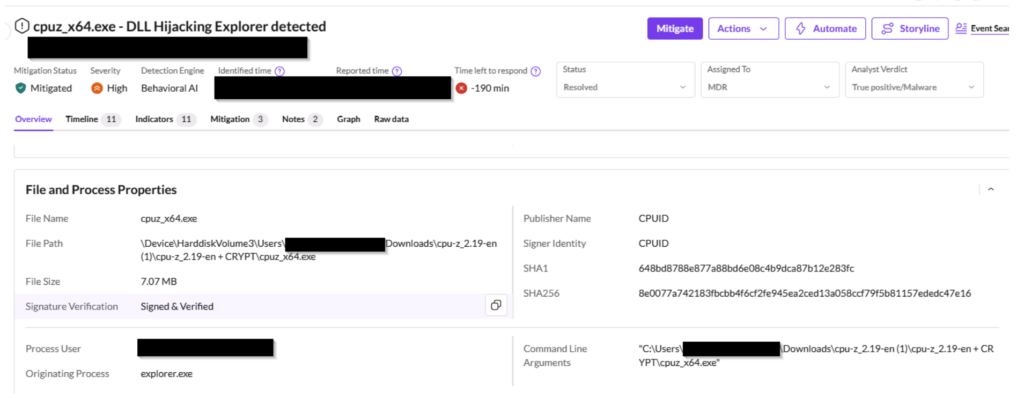
Step 4: Post-Incident Analysis – Understanding the Attack Chain
After the immediate response, perform a deep investigation. For the CPU-Z incident, the chain was:
cpuz_x64.exe (legitimately signed) → spawns PowerShell → spawns csc.exe (C# compiler) → spawns cvtres.exe → reflects malicious CRYPTBASE.dllKey questions to answer:
- How did the initial binary get modified? (API compromise)
- What was the payload? (data-stealing shellcode)
- Were any other systems affected? (check lateral movement)
- What indicators can be added to detection rules?
Action: Export the full process tree, memory dumps, and network connections. Use a threat intelligence feed to correlate the attacker infrastructure (e.g., domains used for C2). Update your EDR rules to include the specific IOCs (file hashes, IPs, domains).
Common Mistakes
Even experienced defenders can fall into these traps when facing supply chain attacks:
- Trusting vendor signatures blindly. The CPU-Z binary was signed and hosted on the official site. Digital signatures only prove the code came from that vendor, not that it's benign.
- Ignoring process anomalies. Many security teams focus on file-based detection (hashes, signatures) and overlook behavioral indicators. A legitimate installer should not be compiling C# code or performing process injection.
- Delayed response. Waiting for human review before taking action can allow the attack to spread. Automated termination (with careful tuning) is essential for supply chain threats that run quickly.
- Lack of baseline for normal software behavior. Without understanding what CPU-Z normally does, how can you detect when it's doing something malicious? Build a baseline for all software in your environment.
- Ignoring software updaters and tools. CPU-Z, HWMonitor, PerfMonitor are common IT tools but rarely monitored closely. Attackers target them precisely because they are trusted and widespread.
Summary
The CPU-Z watering hole attack demonstrates a systemic shift in threat actor tactics: compromising the software supply chain at the distribution layer. By leveraging API-level access, attackers can serve signed, seemingly legitimate binaries that contain hidden payloads. Defending against such attacks requires shifting from signature-based detection to behavioral AI-driven EDR. The five key indicators—anomalous API resolution, reflective loading, RWX allocation, process injection, and heuristic shellcode—provide a reliable detection framework. Automated response (termination and quarantine) and thorough post-incident analysis are crucial to contain and learn from the incident. Finally, never assume trust in a signed binary; verify behavior. With these practices, you can significantly reduce the risk of supply chain compromises in your organization.