In the rapidly evolving world of large language models (LLMs) and retrieval-augmented generation (RAG), efficient memory management is a critical bottleneck. One of the most promising solutions to emerge is TurboQuant, a sophisticated algorithmic suite and library recently introduced by Google. Designed to tackle the heavy memory footprint of key-value (KV) caches, TurboQuant applies advanced quantization and compression techniques that dramatically reduce storage requirements without sacrificing model quality. Whether you’re building a custom chatbot, a vector search engine, or a full-scale RAG pipeline, understanding how TurboQuant works—and why it matters—can give you a significant edge. Here are ten things you need to know about this game-changing technology.
1. KV Cache Compression: The Core Problem
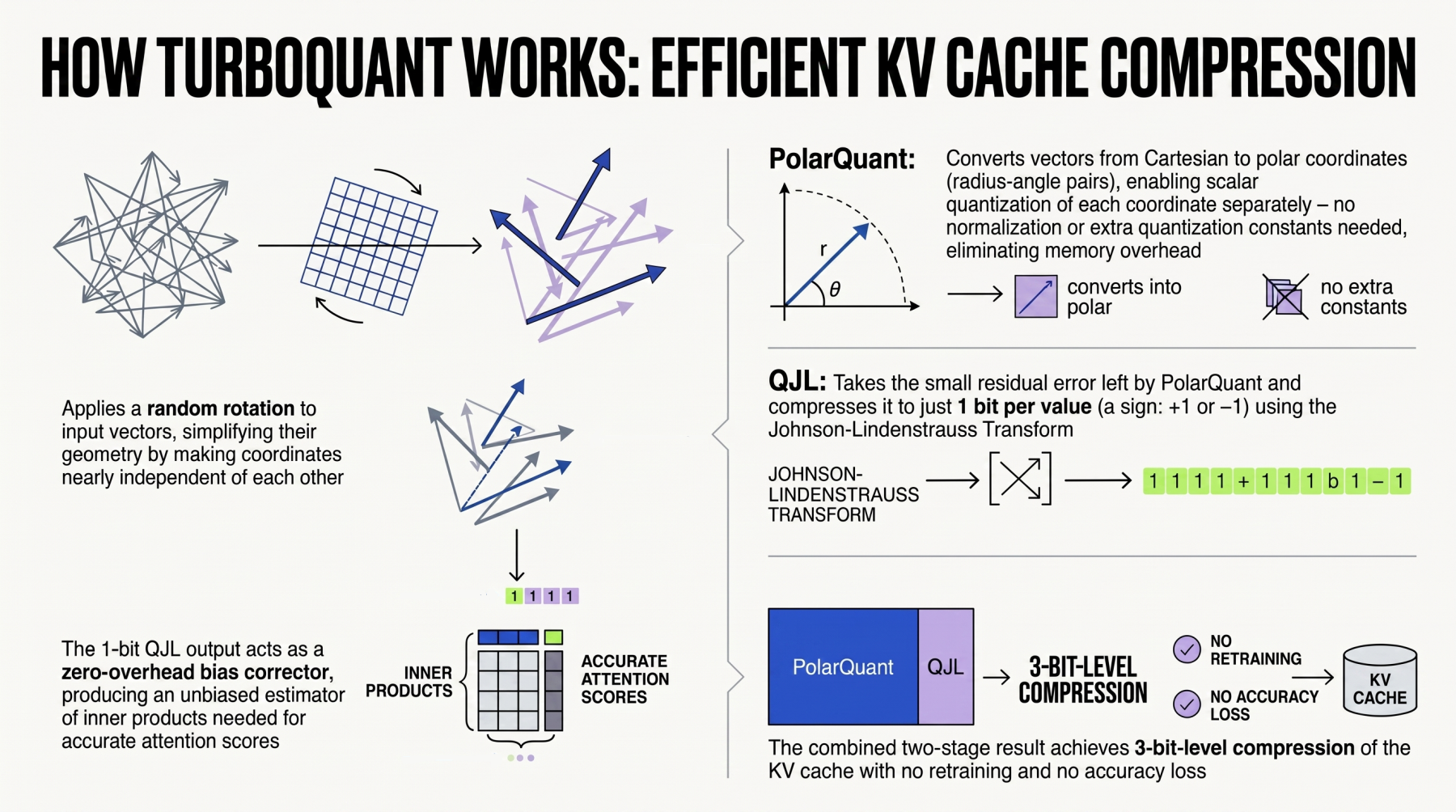
Large language models generate text by processing tokens sequentially. At each step, the model must remember its previous computations through a key-value (KV) cache. For long sequences, this cache quickly consumes gigabytes of GPU memory. In fact, for a 70B-parameter model running on a 40GB GPU, the KV cache alone can occupy over 80% of available memory. KV cache compression is therefore essential to scale deployment, reduce latency, and cut costs. TurboQuant directly addresses this memory wall by compressing the KV matrices with minimal accuracy loss.
2. TurboQuant’s Dual Focus: LLMs and Vector Search
Google designed TurboQuant not just for language models but also for vector search engines—a core component of RAG systems. While LLMs rely on dense transformers, vector search engines index and retrieve high-dimensional embeddings. Both face similar memory challenges: billion-scale index structures and large cache sizes. TurboQuant provides a unified quantization toolkit that optimizes memory usage across these two domains, making it a versatile addition to any AI infrastructure.
3. How Quantization Differs from Standard Compression
Standard compression methods (like gzip) work on byte streams and are lossless or lossy for file storage. In contrast, quantization reduces the number of bits used to represent each number in model weights or activations—typically from 16-bit floating point to 4-bit or even 2-bit integers. TurboQuant employs advanced quantization schemes that keep the model’s output distribution nearly identical, while slashing memory by 4x or more. This is fundamentally different from pruning or distillation; it directly alters the numeric precision of cached values.
4. Key Innovations: Adaptive Bit-Width and Outlier Handling
Many quantization methods suffer from outlier values—extreme numbers that distort the compressed representation. TurboQuant introduces adaptive bit-width assignment, where different parts of the KV cache get different numbers of bits based on their statistical properties. For example, attention heads with high variance may receive 6 bits, while stable heads can use 2 bits. This per-tensor or per-head granularity, combined with outlier-aware scaling, achieves high compression ratios without degradation.
5. Seamless Integration into Existing Pipelines
Deploying new compression techniques often requires rewriting inference code or modifying model architectures. TurboQuant is released as a library with a clean API that can be hooked into popular frameworks like Hugging Face Transformers, PyTorch, and TensorFlow. It supports post-training quantization—meaning you don’t need to retrain or fine-tune the model. A few lines of code can compress the KV cache of any transformer-based LLM, making adoption painless.
6. Benchmarks: Memory Savings and Latency Improvements
According to Google’s internal benchmarks, TurboQuant achieves up to 4x compression of KV caches with less than 1% accuracy drop on standard language tasks. For vector search indexes, it reduces memory usage by 3–5x while preserving recall rates. In end-to-end RAG pipelines, this translates to 50% lower GPU memory consumption and up to 30% faster response times. These numbers make TurboQuant one of the most effective compression tools for production AI systems.
7. Open-Source Availability and Community
TurboQuant is open-source under an Apache 2.0 license, hosted on GitHub. Google has provided extensive documentation, example notebooks, and a dedicated discussion forum. The community has already contributed optimizations for edge devices (e.g., smartphones) and support for newer hardware like NVIDIA H100 and AMD MI300. This collaborative ecosystem ensures that the library stays up-to-date with the latest architectures and quantization research.
8. Compatibility with Other Optimization Techniques
Quantization is not the only way to speed up LLMs. Techniques like speculative decoding, flash attention, and weight pruning can be combined with TurboQuant. The library is designed to work alongside these methods without conflict. For instance, you can use FlashAttention for efficient kernel-level attention while applying TurboQuant to compress the key-value cache—resulting in multiplicative memory gains. This modularity is critical for building high-performance inference stacks.
9. Real-World Use Cases: From Chatbots to Enterprise Search
Several companies have already adopted TurboQuant in production. Customer support chatbots use it to maintain long conversation histories without requiring expensive GPU clusters. Enterprise search RAG systems compress their vector indexes by 4x, enabling real-time retrieval over millions of documents on a single server. Medical summarization tools leverage the low-latency benefits to process lengthy patient records. The common thread is that TurboQuant enables running larger models or longer contexts within the same hardware budget.
10. Limitations and Future Directions
No technology is perfect. TurboQuant currently focuses on post-training quantization, which may not achieve the same accuracy as quantization-aware training for extremely aggressive compression (e.g., 2-bit). Additionally, its outlier handling, while effective, adds computational overhead during the compression step (though it’s amortized by the inference savings). Google is actively researching quantization-aware fine-tuning and hardware-specific kernels to push compression further. Expect future versions to support dynamic bit-width assignment during inference.
In summary, TurboQuant represents a major leap forward in making large language models and vector search engines memory-efficient and cost-effective. By compressing the KV cache up to 4x with negligible accuracy loss, it unlocks new possibilities for long-context applications, real-time retrieval, and on-device AI. As the open-source community continues to refine and extend the library, TurboQuant is set to become a standard tool in every ML engineer’s arsenal. If you’re looking to optimize your RAG pipeline or scale your LLM deployment, this is one technology you simply cannot afford to ignore.