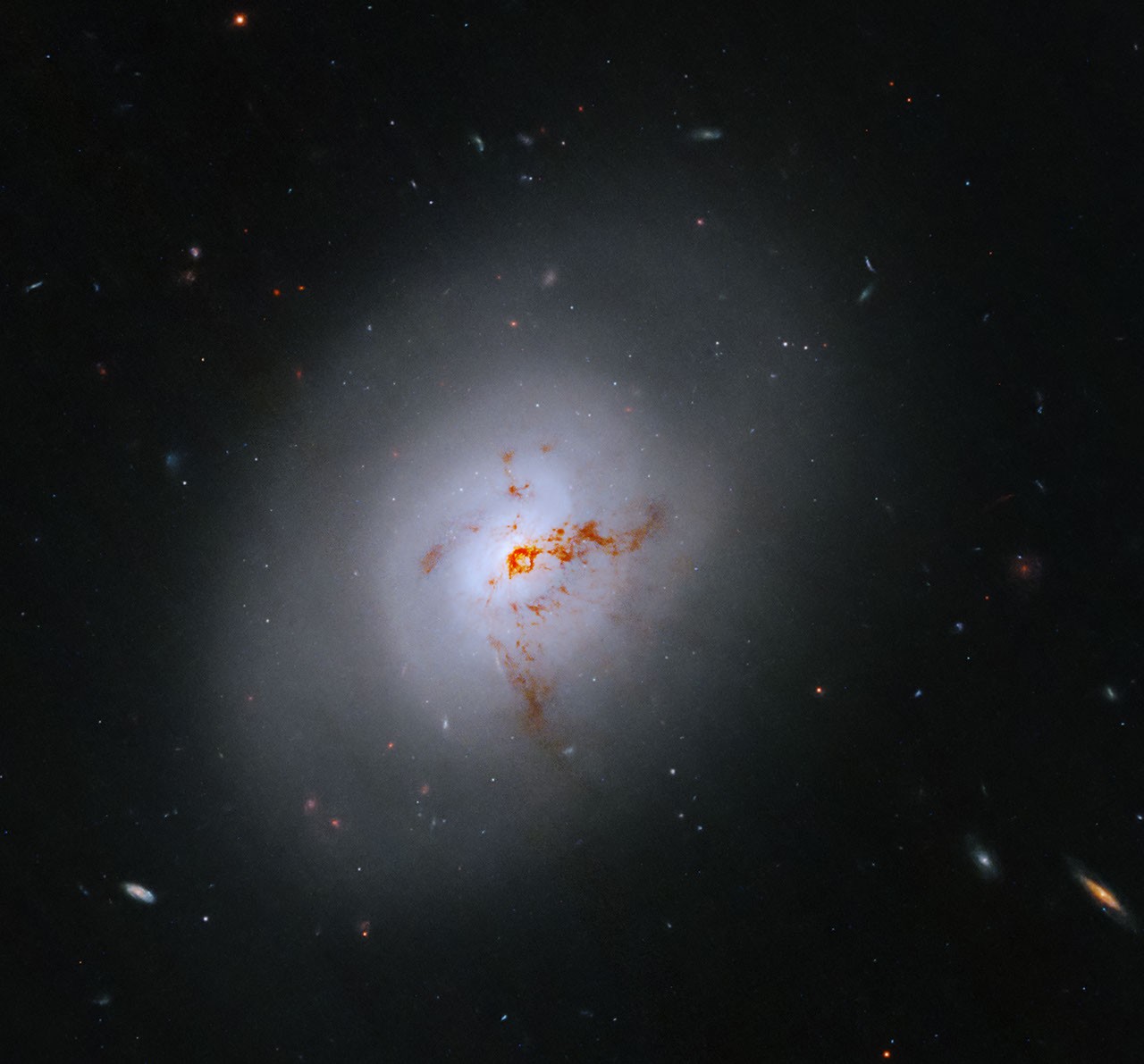
This Q&A explores the fascinating lenticular galaxy NGC 1266, as imaged by the NASA Hubble Space Telescope. Located about 100 million light-years away in the constellation Eridanus, this rare post-starburst galaxy offers a unique snapshot of galactic evolution. The image shows a bright center, hints of spiral structure, and dusty filaments, with distant galaxies shining through its outer regions. Below, we answer key questions about its classification, history, and significance.
What is NGC 1266?
NGC 1266 is a lenticular galaxy captured by the Hubble Space Telescope. It lies roughly 100 million light-years from Earth in the constellation Eridanus (the Celestial River). The galaxy has a bright central bulge and a flattened disk, reminiscent of spiral galaxies, but lacks spiral arms and shows little star formation—traits typical of elliptical galaxies. Its most intriguing feature is its status as a post-starburst galaxy, meaning it underwent a major burst of star formation in the past but has since quieted down. This makes it a rare evolutionary bridge between active star-forming spirals and quiescent ellipticals.
What is a lenticular galaxy?
A lenticular galaxy is a transitional type that falls between spirals and ellipticals on the Hubble sequence. Like spirals, lenticulars have a prominent central bulge and a disk, but they lack spiral arms and contain very little gas and dust needed for new star formation. In these ways, they resemble elliptical galaxies. The term "lenticular" comes from their lens-like shape when viewed edge-on. Astronomers believe lenticulars may form from spiral galaxies that have lost their gas through interactions or mergers, or from elliptical galaxies that have accreted material. NGC 1266 is a classic example, though its classification is further complicated by its post-starburst nature.
Why is NGC 1266 called a post-starburst galaxy?
NGC 1266 is classified as a post-starburst galaxy because it experienced a intense period of star formation roughly 500 million years ago and has since shut down its star-forming regions. While it still contains a young population of stars left over from that burst, there are very few areas where new stars are being born. Such galaxies are rare—only about 1% of galaxies in the local universe are post-starburst. They represent a short-lived phase when a galaxy transitions from a star-forming spiral-like state to a passive elliptical-like state. In NGC 1266, the burst was likely triggered by a minor merger with another galaxy.
What caused the transition observed in NGC 1266?
Astronomers believe that a minor merger with another galaxy about 500 million years ago set NGC 1266 on its current path. The merger funneled gas into the galaxy's center, sparking a burst of new star formation and increasing the mass of its central bulge. At the same time, gas was directed toward the supermassive black hole at the core, fueling an active galactic nucleus (AGN). This AGN now heats and expels remaining gas, shutting down further star formation. The galaxy is now in a transitional phase where it still has young stars but no active star-forming regions, slowly evolving into a quieter elliptical galaxy. This process illustrates how mergers can dramatically reshape galaxies.
What does the Hubble image reveal about NGC 1266?
The Hubble image shows NGC 1266 as a bright, lens-shaped object with a glowing center and subtle hints of spiral structure, but no clear arms. Reddish-brown clumps and filaments of dust partially obscure the galaxy's face, betraying remnants of past activity. Through the galaxy's diffuse outer regions, distant background galaxies shine in red, blue, and orange light, dotting the black space around it. The image highlights the galaxy’s complex internal structure and its position against a rich field of faraway galaxies. This visual evidence supports its classification as a lenticular galaxy undergoing a post-starburst phase, with dust and gas still present but not forming new stars.
How rare are post-starburst galaxies like NGC 1266?
Post-starburst galaxies are extremely rare in the local universe, making up only about 1% of the galaxy population. Their scarcity is because the post-starburst phase is brief—typically lasting only a few hundred million years—before the galaxy settles into a quiescent elliptical state. Finding one like NGC 1266 provides astronomers with a valuable laboratory to study the processes that halt star formation and transform galaxies. The combination of a recent merger, a supermassive black hole, and a young stellar population makes it an ideal target for understanding galactic evolution. By studying such objects, scientists can piece together the life cycles of galaxies.
What is the significance of studying NGC 1266?
Studying NGC 1266 helps astronomers understand how galaxies evolve from star-forming spirals to dormant ellipticals. Its post-starburst nature offers a snapshot of a critical transition phase that is normally hard to catch. The galaxy's minor merger history and active black hole also shed light on the role of supermassive black holes in regulating star formation. Furthermore, the detailed Hubble image allows researchers to examine the distribution of dust and stellar populations. Each piece of information contributes to a broader model of galaxy evolution—showing how interactions, gas flows, and black hole feedback work together to shape the universe we see today. NGC 1266 is a cosmic laboratory for these fundamental processes.