When you think of scorpions, images of two formidable pincers (chelae) and a curved, venomous stinger (telson) likely come to mind. These ancient arachnids have long been icons of both fear and fascination. But what if we told you that these already impressive weapons are secretly reinforced with metals like zinc, manganese, and iron? That’s exactly what scientists have known since the 1990s—but the big question has always been: Is this a deliberate evolutionary adaptation or just accidental environmental contamination? A new study published in the Journal of The Royal Society Interface now provides a clear answer: scorpions have evolved this metal reinforcement on purpose, making their offensive tools even more durable and efficient.
From Accidental Absorption to Intentional Evolution
For decades, researchers have detected trace amounts of heavy metals in the exoskeletons of various arthropods, including scorpions. However, the origin of these metals remained a mystery. The most common assumption was that scorpions simply pick up these elements from the soil, water, or prey—basically, environmental contamination. But Sam Campbell, a biologist at the University of Queensland in Australia, suspected something more was going on. “That the metals are there has been known since the 1990s,” Campbell explains. “What we didn’t know was whether scorpions evolved to be like that or if it was accidental and they were just picking the metals up from the environment.”
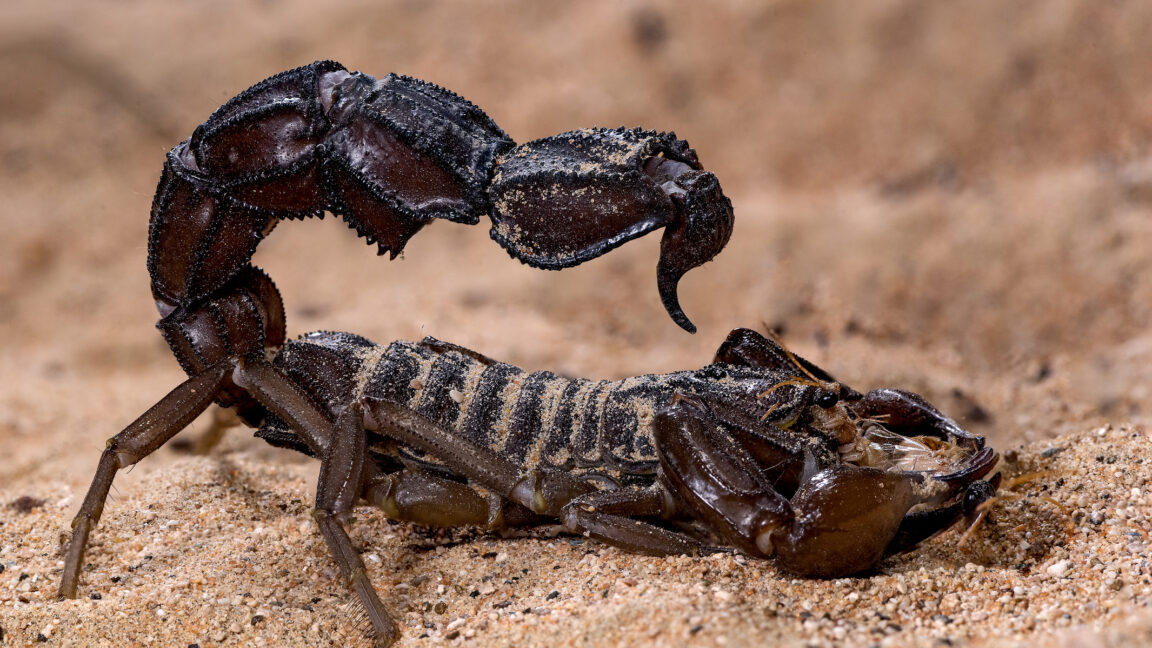
To solve this puzzle, Campbell and his team decided to take a closer look at how metals are distributed across the stingers and pincers of different scorpion species. If the metals were merely environmental contaminants, you would expect them to be spread evenly across the body or randomly deposited. Instead, the researchers found something far more deliberate.
The Study: Mapping Metal Distribution in Scorpion Weapons
The team examined multiple scorpion species, focusing on two key structures: the pedipalps (pincers) and the telson (stinger). Using advanced chemical imaging techniques, they created detailed maps of metal concentrations. The results were striking:
- Zinc was heavily concentrated in the cutting edges of the pincers and the tip of the stinger.
- Manganese and iron were found in reinforcing layers beneath the outer cuticle, especially in areas that experience mechanical stress.
This precise localization suggests that the metals are not just random contaminants but are actively deposited to strengthen specific parts of the exoskeleton. In fact, the study revealed that the metal enrichment is so consistent across species that it must be genetically guided. “Based on our data, there was nothing accidental about it,” Campbell states.
How Do These Metals Make Scorpions Tougher?
Metals like zinc, manganese, and iron are known to increase the hardness and wear resistance of biological materials. For example:
- Zinc can be incorporated into the chitin-protein matrix to create a hard, mineralized composite—similar to how some spiders use zinc to harden their fangs.
- Manganese and iron often form metal-oxygen bridges between protein fibers, enhancing the structural integrity and reducing fracturing when biting or stinging.
In essence, these metals act like biological armor plating, turning already effective weapons into even more durable tools. The pincers become better at crushing prey, and the stinger remains sharp even after repeated use.
Implications for Biology and Biomimicry
Understanding that scorpions have evolved this metal-reinforcement mechanism opens up fascinating avenues for both evolutionary biology and materials science. First, it suggests that many arthropods may have similar hidden adaptations. Spiders, ants, and even mantis shrimp have also been found with metal-enriched appendages—though each species appears to use a unique combination of elements. Scorpions now join that list with a particularly sophisticated system.
Evolutionary Advantage: Why Bother?
Why would natural selection favor metal incorporation? The answer likely lies in the harsh environments scorpions inhabit. Many species live in deserts, where they must catch prey that is fast and often armored (like beetles or other arachnids). A stinger that stays sharper longer and pincers that can crush without breaking are clear survival advantages. Additionally, metal reinforcement reduces the need to repair exoskeleton damage, saving energy that can be used for reproduction and hunting.
From Scorpions to Super-Materials
Scientists are already looking at how to replicate this natural design. By understanding how scorpions selectively deposit metals into cuticle, researchers hope to develop new materials for robotics, surgical tools, and protective gear. Imagine a surgical scalpel that incorporates zinc to stay sharp for dozens of uses, or a robotic gripper that resists wear when handling rough objects. The scorpion’s metal-infused exoskeleton could inspire a new generation of bio-inspired materials.
What’s Next? Unanswered Questions
The study answers one big question, but raises others. For instance:
- How exactly do scorpions control where and when to deposit metals? Is it a continuous process or triggered by molting?
- Do different species use different metal ratios based on their diet or habitat?
- Could this mechanism be manipulated to make other arthropod exoskeletons stronger?
Campbell and his colleagues are now planning to investigate the genetic and biochemical pathways behind metal deposition. They also want to test whether scorpions that lose their claws or stingers can regenerate them with the same metal concentrations—a key clue to understanding whether the process is hardwired or flexible.
Conclusion: Nature’s Metallurgists
Scorpions have long been admired for their ancient, robust design. This new research reveals that they are even more sophisticated than we imagined—actively incorporating metals into their weapons like miniature metallurgists. Far from being accidental, the zinc, manganese, and iron in their pincers and stingers represent a precise evolutionary adaptation that makes these arachnids even deadlier and more resilient. As we continue to unlock the secrets of the natural world, the scorpion reminds us that often the toughest solutions are forged from a mix of biology and chemistry.
Read the full study: “Metal concentrations in scorpion chelae and telson: evidence for adaptive biomineralization” in Journal of The Royal Society Interface.